A balanced, evidence-informed discussion.
Introduction
Chronic back pain is one of the most common and complex conditions encountered in clinical practice. For individuals whose pain persists despite initial treatment, surgery can understandably feel like a logical next step.
However, current clinical guidelines and research increasingly recommend structured, exercise-based rehabilitation as the first-line approach for most cases of chronic non-specific back pain, with surgery reserved for carefully selected situations.
This article outlines what the evidence shows, when surgery is clearly indicated, and why conservative rehabilitation is often recommended before surgical intervention, while fully recognising the essential and appropriate role of surgeons in managing spinal pathology.
Important Clinical Disclaimer
This article is intended for general educational purposes only and does not constitute medical advice. Musculoskeletal conditions and back pain vary significantly between individuals, and treatment decisions should always be made following a comprehensive clinical assessment by an appropriately qualified healthcare professional.
Both surgical and non-surgical interventions play important roles in the management of back pain. The information presented here reflects current evidence and clinical guidelines but does not replace individualised medical decision-making or specialist referral where clinically indicated.
Understanding Chronic Back Pain
Chronic back pain is commonly defined as pain persisting for longer than three months. In many cases, it is classified as non-specific, meaning that no single structural cause can be confidently identified as the sole source of symptoms.
Large imaging studies have demonstrated that:
- Disc degeneration, disc bulges, and facet joint changes are highly prevalent in people without pain
- These findings increase with age
- Imaging findings alone have limited ability to predict pain severity or disability
A widely cited systematic review by Brinjikji et al. (2015) concluded:
“Degenerative spine imaging findings are common in asymptomatic individuals and increase with age.”¹ This does not mean imaging is unhelpful, but rather that structural findings must be interpreted carefully within the broader clinical context.
When Surgery Is Clearly Indicated
Surgery plays a critical and often life-changing role in specific clinical scenarios. Most international guidelines agree that surgical intervention is appropriate when there is:
- Progressive neurological deficit (e.g. worsening motor weakness)
- Cauda equina syndrome (bowel or bladder dysfunction)
- Spinal instability
- Significant trauma
- Infection, tumour, or fracture
- Clearly defined nerve root compression with correlating clinical signs that fails appropriate conservative management
In these circumstances, surgery is not only appropriate—it may be essential. This article does not question the value of surgery in such cases.
When Surgical Outcomes Are Less Predictable
In cases of chronic non-specific back pain, where there is no clear surgical target, outcomes following surgery are more variable. High-quality research has shown that:
- Surgery does not consistently outperform well-structured conservative care in long-term outcomes
- Short-term symptom relief following surgery may diminish over time
- A subset of patients experience persistent pain despite technically successful procedures
A Cochrane review on lumbar fusion for chronic low back pain concluded:
“There is insufficient evidence that spinal fusion surgery is more effective than conservative treatment for chronic low back pain.”²
Similarly, a randomised controlled trial by Brox et al. (2003) reported that:
“Cognitive intervention combined with exercises produced outcomes comparable to lumbar fusion surgery in patients with chronic low back pain.”³
These findings do not suggest that surgery is ineffective, but rather that its benefits are condition-specific and highly dependent on appropriate patient selection.
Why Conservative Rehabilitation Is Often Recommended First
Most contemporary clinical guidelines recommend conservative management as the initial approach for chronic non-specific back pain. For example:
- NICE (UK) guidelines recommend exercise-based programmes as first-line care for persistent low back pain and sciatica⁴
- The American College of Physicians recommends exercise, education, and multidisciplinary rehabilitation before invasive procedures⁵
These recommendations reflect growing recognition that chronic back pain is often influenced by:
- Physical deconditioning
- Nervous system sensitisation
- Fear of movement
- Psychosocial stressors
These contributors are not addressed by surgery alone.
What Exercise-Based Rehabilitation Aims to Achieve
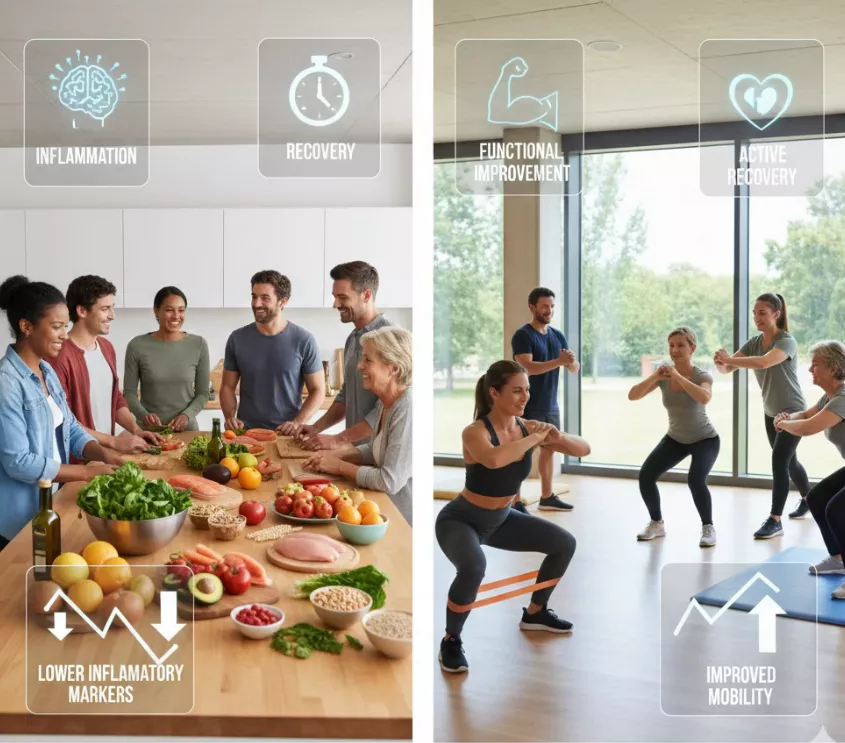
Modern exercise-based rehabilitation extends beyond strengthening muscles alone. Well-designed programmes aim to:
- Improve physical capacity and tolerance
- Reduce fear-based movement avoidance
- Restore confidence in movement
- Improve functional ability and participation
- Support long-term self-management
A Cochrane review by Hayden et al. (2021) found that:
“Exercise therapy results in modest but clinically meaningful improvements in pain and function for adults with chronic low back pain.”⁶ Importantly, these benefits were achieved with low risk of harm.
Comparing Outcomes: Exercise and Surgery
When interpreting comparative outcomes, it is important to distinguish between:
- Short-term symptom relief
- Long-term function and disability
- Risk and complication profiles
Evidence suggests that:
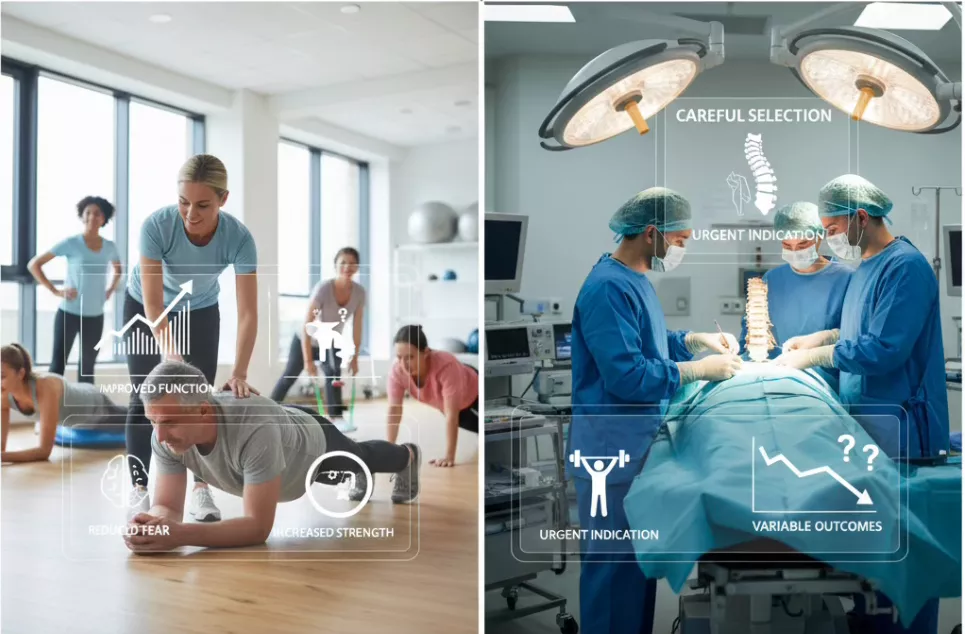
- Surgery may provide more rapid symptom relief in selected cases
- Long-term outcomes often converge with those of conservative care
- Exercise-based rehabilitation carries substantially lower risks
Deyo et al. (2010) highlighted rising complication rates and costs associated with lumbar spine surgery, reinforcing the importance of careful patient selection and conservative options where appropriate⁷.
The Role of the Nervous System and Beliefs
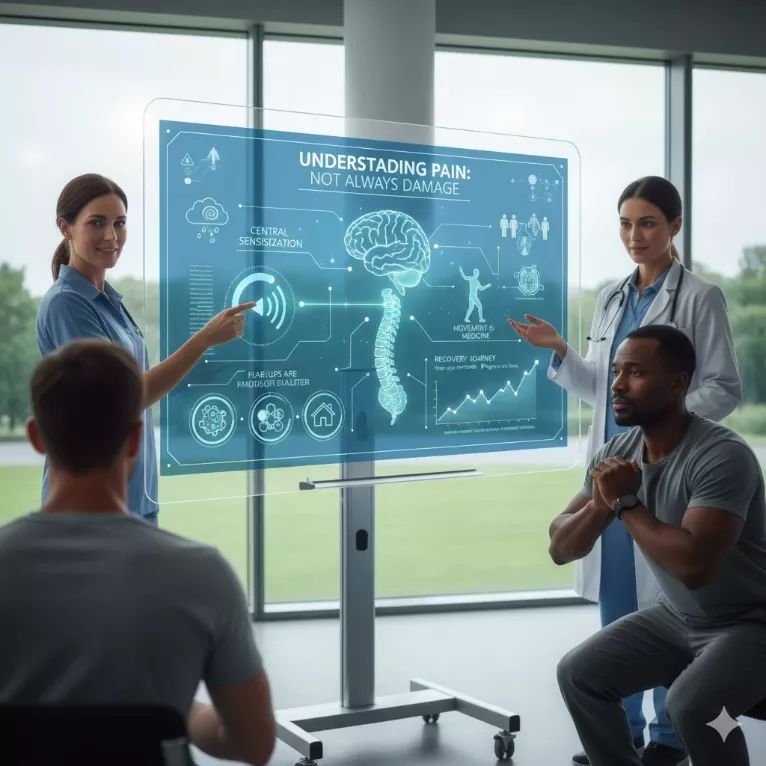
Chronic back pain is increasingly understood to involve central nervous system processes, not only structural pathology. Fear of movement, catastrophic thinking, and reduced confidence have been shown to strongly predict disability and delayed recovery. Addressing these factors through graded exercise and education is a key mechanism by which conservative rehabilitation improves outcomes.
Louw et al. (2011) demonstrated that combining exercise with pain neuroscience education resulted in:
- Reduced pain intensity
- Reduced fear-avoidance behaviours
- Improved functional movement⁸
Surgery and Rehabilitation Are Complementary, Not Competing
It is important to emphasise that surgery and rehabilitation are not opposing approaches.
In clinical practice:
- Rehabilitation is often appropriate before surgery
- Rehabilitation is essential after surgery
- Conservative care may help clarify who is most likely to benefit from surgical intervention
Optimal patient outcomes rely on collaboration between surgeons, rehabilitation professionals, and medical practitioners, rather than competition between disciplines.
Making a Balanced, Informed Decision
Decisions regarding surgery should involve:
- Comprehensive clinical assessment
- Clear explanation of expected benefits and limitations
- Consideration of conservative management options
- Shared decision-making between patient and clinician
For many individuals, surgery remains an appropriate option—but not always the first or only one.
Final Thoughts
Current evidence does not suggest that surgery lacks value. Instead, it shows that for many people with chronic non-specific back pain, structured exercise-based rehabilitation can provide comparable long-term outcomes with fewer risks.
This is why modern guidelines recommend beginning with conservative rehabilitation, reserving surgery for cases where it is clearly indicated or where non-surgical care has been appropriately exhausted.
A balanced, patient-centred approach—grounded in evidence and professional collaboration—offers the best opportunity for meaningful, sustainable recovery.
References & Further Reading
- Brinjikji W et al. Imaging features of spinal degeneration in asymptomatic populations. AJNR, 2015.
- Gibson JNA, Waddell G. Surgery for degenerative lumbar spondylosis. Cochrane Database, 2005.
- Brox JI et al. Lumbar fusion versus cognitive intervention and exercises. Spine, 2003.
- NICE. Low back pain and sciatica in over 16s: assessment and management., 2020.
- Qaseem A et al. Noninvasive treatments for acute, subacute, and chronic low back pain. Ann Intern Med, 2017.
- Hayden JA et al. Exercise therapy for chronic low back pain. Cochrane Database, 2021.
- Deyo RA et al. Trends and complications in lumbar spine surgery. JAMA, 2010.
- Louw A et al. Pain neuroscience education combined with exercise. Arch Phys Med Rehabil, 2011.